Murder of Arthur Gwynn Geiger
The Big SleepThe murder of Arthur Gwynn Geiger is the first killing at the center of the investigation begun by Philip Marlowe. In Geiger’s Laurel Canyon house, Marlowe finds the bookseller dead and Carmen Sternwood incapacitated beside a camera aimed at her; later he concludes that her chauffeur, Owen Taylor, killed Geiger after catching him photographing Carmen. The killing exposes Geiger’s blackmail scheme, but its evidence is quickly scattered among private hands and an official account that obscures the truth.
Background and Circumstances
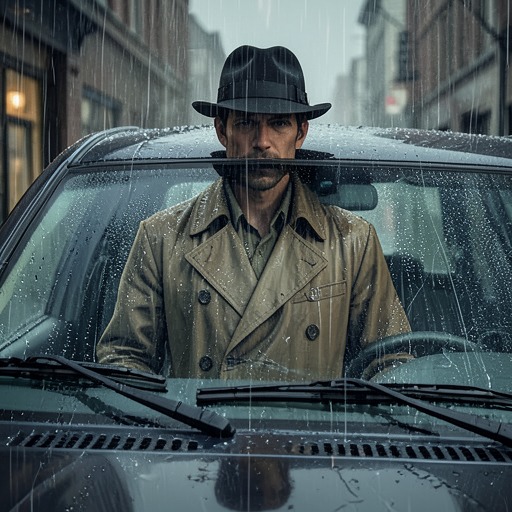
Geiger’s death occurs during Marlowe’s surveillance of his movements. Marlowe follows him from the bookstore up Laurel Canyon Drive and onto the rain-darkened Laverne Terrace, where Geiger enters a small house screened from the street by a box hedge. Later, a maroon Packard registered to Carmen arrives, and a woman enters the house. Marlowe waits nearby, not yet knowing what the visit means.
At 7:20, a sudden flash comes from the house, followed by a scream. Marlowe hurries to the entrance; just as he reaches for the knocker, three shots sound inside. He then hears footsteps retreating down the rear stairs and a car driving away. The sequence gives him the essential outline of a killing, but not the shooter’s identity: someone has fired three times and escaped while Marlowe is outside.
The Crime Scene
Marlowe enters through a French window after failing to force the front door. Inside, he finds Carmen sitting rigidly in a chair, apparently unconscious and making a faint chuckling sound. She is dressed only in earrings, and Marlowe recognizes her as incapacitated rather than a participant able to explain what happened. The room also contains the aftermath of a flash and the smell of ether, details that connect her condition to Geiger’s photographic setup.
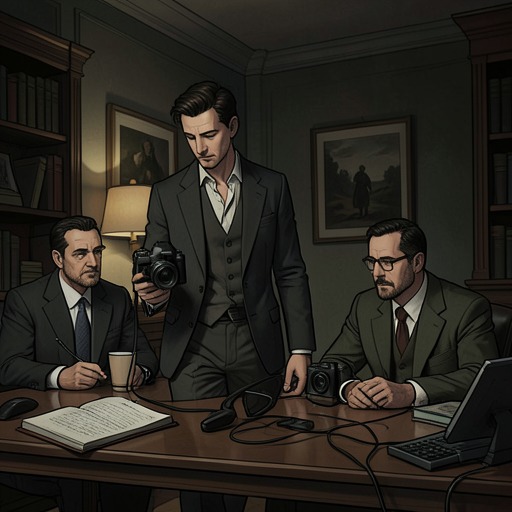
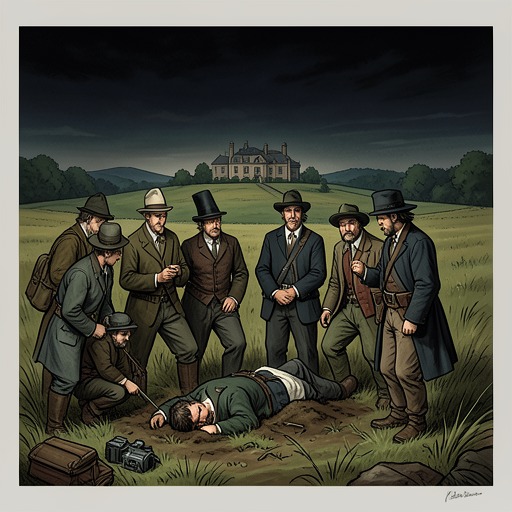
Geiger lies dead on the floor, wearing Chinese-style clothes. Beside him stands an object disguised as a totem pole, with a camera lens trained on Carmen and a blackened flashbulb attached. Marlowe recognizes that this flash produced the burst of light he saw from outside and that Carmen’s scream followed it. The three shots and the fleeing footsteps complete the immediate sequence: Geiger was killed in the room, while the camera was pointed at Carmen.
The crucial photographic plate is missing. Marlowe searches the concealed camera and the floor around Geiger but finds no plateholder, leaving open whether the shooter took it or someone else removed it. Geiger’s method has turned Carmen’s exposure into portable evidence, while the missing negative means the scene cannot by itself establish who now possesses the image.
Marlowe dresses Carmen, gets her out of the house, and takes her home. Before leaving, he finds a coded notebook in a locked steel box in Geiger’s desk and pockets it. These acts move evidence away from the scene: Carmen is removed from the immediate danger of discovery, while the notebook becomes a record that can link Geiger’s private operation to other people. Marlowe later finds that a photograph of Carmen has been sent to Vivian Regan, confirming the danger posed by the image even though the plateholder was missing from the house.
Reconstructing the Killing
The account Marlowe gives Joe Brody supplies a motive and a sequence. He reasons that Taylor, who was devoted to Carmen, went to Geiger’s house to confront him over his treatment of her. In Marlowe’s reconstruction, Taylor entered by the back way with a gun and a jimmy, caught Geiger photographing Carmen, and shot him. Taylor then fled with the photographic negative. Brody, who had been following events for his own purposes, pursued Taylor and took the plateholder from him; Marlowe infers that Brody’s possession of the image came through this encounter rather than from killing Geiger himself.
Marlowe later defends this reconstruction to Taggart Wilde and Captain Cronjager. He concedes that Brody could physically have been the shooter, but judges that explanation inconsistent with Brody’s conduct and commercial aims. Brody wanted access to Geiger’s illicit book business and intended to use the compromising photograph to extort the Sternwoods; Marlowe argues that Taylor, not Brody, had the direct emotional motive and opportunity. Taylor was also in a family car without permission, and Marlowe believes he would have killed Geiger in front of Carmen to stop the photographing.
The reconstruction remains an inference rather than an eyewitness account of the shooting. Marlowe explicitly marks parts of his explanation of what happened to Geiger’s body as guesswork, and the police presentation subsequently assigns the murder to Brody. The narrative therefore distinguishes the physical evidence, Marlowe’s reasoned conclusion about Taylor, and the version entered into public circulation.
Evidence, Secrecy, and Public Account
The photograph becomes one of the case’s principal instruments of coercion. A messenger delivers an image of Carmen to Vivian, and Marlowe later tells Carmen that the missing photograph was probably taken by Brody. His instruction that she tell no one she had been at Geiger’s house shows how the investigation is also an effort to keep her presence, and the circumstances of the image, from becoming public knowledge.
When Marlowe presents the exhibits to Wilde, the materials include Carmen’s signed notes, Geiger’s card to General Guy Sternwood, photographs of Carmen, and the coded notebook. He argues that Geiger’s bookstore is a front and offers to testify that the coded book came from the store; he also says Geiger’s secretary, Agnes Lozelle, can describe its business. The evidence makes the killing inseparable from an illicit operation and the blackmail it enabled, but it also threatens to expose the authorities who allowed the store to function.
Marlowe does not tell the officials everything. In his account of the case, he acknowledges leaving out Carmen’s visit to Brody’s apartment and Eddie Mars’s visit to Geiger’s that afternoon. The omission demonstrates that the evidence presented to the authorities is selective, even as he insists on the truth of his reconstruction of Taylor’s motive. The resulting official story, printed in the morning papers, says Brody killed Geiger and Carol Lundgren killed Brody, while Taylor is described separately as the driver of a suicide car. It omits the Sternwoods and Marlowe, and gives Cronjager credit for solving the killings.
The murder thus produces more than a question of who fired the shots. Geiger’s camera, the missing plateholder, the coded notebook, the photographs, Marlowe’s selective testimony, and the newspaper account each carry a different portion of the story. The case’s public resolution conceals the connection between Taylor and Geiger’s death, while Marlowe’s account preserves the motive he believes the official version has erased.